

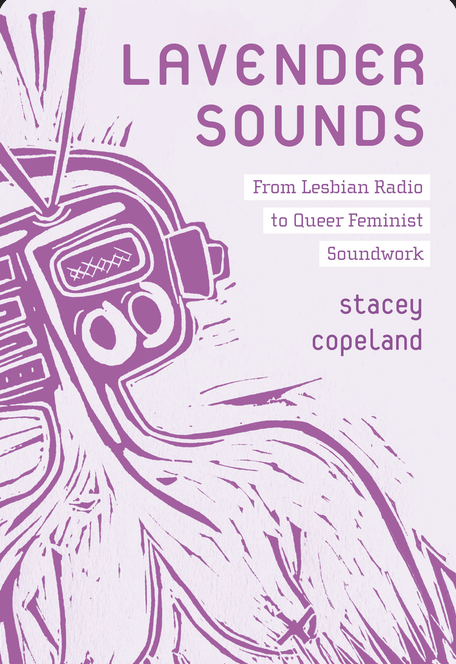
Stacey Copeland (University of Gruningen, Netherlands) : “Lavender Sounds: From Lesbian Radio to Queer Feminist Soundwork” (U. of Michigan Press, 2026)
Bio: Dr. Stacey Copeland is an Assistant Professor of Cultural Heritage & Identity in the Research Centre for Media and Journalism Studies at the University of Groningen, Netherlands. She received her Ph.D. from Simon Fraser University’s School of Communication (Vancouver, Canada). Her book Lavender Sounds: From Lesbian Radio to Queer Feminist Soundwork (UofM Press, 2026) traces lesbian radio history into today’s queer feminist podcasting, exploring the politics, aesthetics, and activism of queer feminist soundwork. Her research on sound, media, and culture appears in journals including Radio Journal and Emerging Media, as well as several edited collections, and she has co-published open-access guides on academic podcasting and soundscape assessment. She currently co-directs the Amplify Podcast Network.
This talk presents Lavender Sounds: From Lesbian Radio to Queer Feminist Soundwork (University of Michigan Press, 2026), a history of queer and lesbian radio in North America told through two under-studied Canadian collectives: The Lesbian Show, which first aired on Vancouver Co-Op Radio (CFRO) in 1979, and Dykes on Mykes, broadcast on CKUT Montreal beginning in 1987. The book’s title draws on lavender’s contested place in queer history – from the McCarthy-era « Lavender Scare » to the « Lavender Menace » protests within second-wave feminism – to ask what it has meant, across five decades, for lesbians, dykes, and queers to take up the microphone.
Lavender Sounds weaves its way through key concepts from across cultural sound studies, feminist media, and queer theory to develop a feminist embodied ear as method: a listening practice attentive to the techno-logics – the entangled technological and ideological structures – through which lesbian and queer radio produced counterpublics. Applying this ear together, we will delve into a close, interpretive account of how these collectives built what Copeland theorizes as an audibility activism: a sonic politics working alongside, and at times against, the visibility politics that have dominated cultural media studies.
Drawing on archival recordings and interviews with contemporary queer podcasters who listen back to this material with the author, the talk traces a set of sonic aesthetics – camp, queerspeak, erotic play – that link 1970s lesbian radio to today’s queer podcasting boom, attending throughout to the techno-logics and networked labor that shape both eras’ struggles for discoverability. Ultimately, together we will ask what a queer feminist history of sound can tell us about who gets to be audible now, and on what terms.
(Sign up here to receive the invite link)